


Establishing the quantified case for why cultural alignment is not just a soft factor. It is a strategic imperative.
This article serves as the first in a series exploring the overlooked yet critical impact of organizational culture in the success or failure of mergers and acquisitions. Its goal is to move beyond intuition and narrative to establish a clear, quantified case for why cultural alignment matters.
Future installments will explore practical solutions, but we begin here by demonstrating the value at stake.
Why Cultural Alignment Matters
The importance of culture in M&A is well documented. According to McKinsey & Company’s report, The Importance of Cultural Integration in M&A: The Path to Success, cultural issues are cited as a leading cause of integration failure. The report notes that 95% of executives believe cultural fit is critical to the success of integration, yet only 25% believe they achieve it effectively.
Adding statistical weight, a recent study published in Springer, Mind the gap: the effect of cultural distance on mergers and acquisitions, shows that cultural misalignment measured using employee review data has a strong correlation with long-term underperformance post-merger. The study concludes that cultural distance measurably reduces enterprise value over time.
Among Executives, the Gap Is Striking
Most leaders recognize the importance of cultural fit. Far fewer believe they can consistently achieve cultural integration effectively.
believe cultural fit is critical to the success of integration
believe they can achieve cultural integration effectively
The Quantifiable Cost
Acknowledging the significance of culture is not enough. We must attempt to quantify it. According to Mercer, as cited in HR Daily Advisor’s article Culture: The Key to M&A Success, the cost of cultural failure can range from $1 million to $5 million per deal, primarily addressing small acquisitions. The article further cites Kincentric, which claims that as many as 45% of employees leave within the first year of a failed integration.
The Oaklin report, M&A: The Hidden Cost of Culture, offers a compelling example: eBay’s acquisition of Skype, where cultural friction led to massive losses and a subsequent write-down of $1.4 billion. These are not abstract risks. They manifest in clear financial terms.
A Ground-Up Model for Cultural Misalignment Costs
Having participated directly in over 50 acquisitions of professional services firms ranging in size from 50 to 500 employees, I have observed cultural misalignment as a recurring and avoidable driver of post-deal value erosion. Building on Kincentric’s turnover projection of 45%, we propose a more conservative figure of 25%, informed by direct industry experience.
Let’s apply this to a 200-consultant firm with average billings of $400,000 per year per consultant. Industry experts suggest a turnover cost of at minimum 50% of annual salary, with ranges reaching 150% or more. The following table provides a ground-up directional estimate for the cost of cultural misalignment in the firm.
This model is directional, not absolute. The real-world cost varies by business type and dependency on tacit knowledge or client relationships. It is also important to consider that the above analysis includes only the cost of employee replacement.
Additional costs related to client retention, intellectual property loss, and on-the-job resignation can only serve to materially amplify this costing analysis.
Culture Is Financial
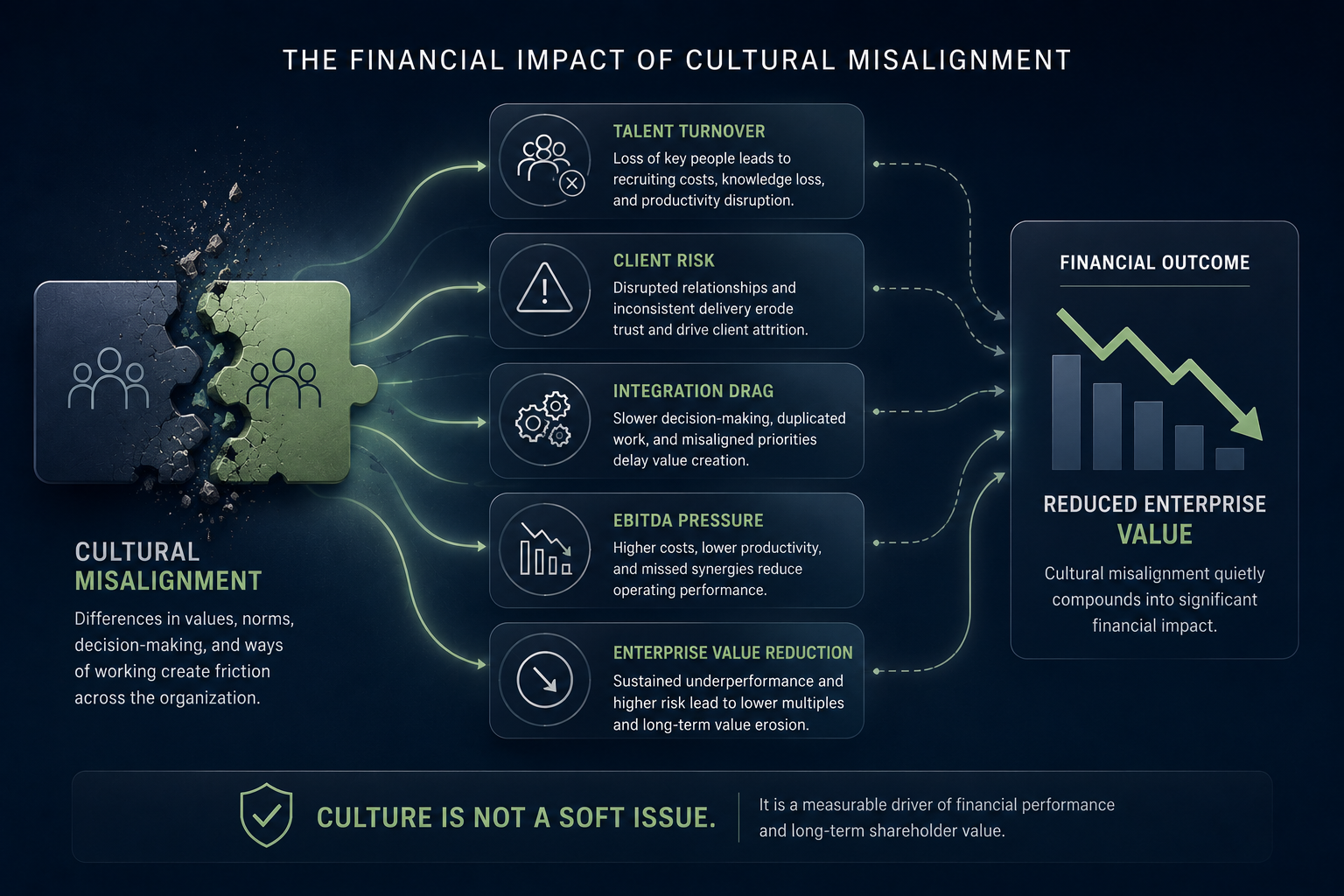
Cultural misalignment creates measurable cost through turnover, disruption, and reduced execution capacity.
Turnover Is Only One Layer
Replacement cost alone can be significant before factoring in client loss, tacit knowledge, and productivity drag.
Alignment Protects Value
Addressing culture proactively gives leaders a better chance to preserve deal value before integration friction compounds.
Conclusion
The evidence is clear: cultural misalignment is not an intangible issue. It results in quantifiable financial damage. As the next article in this series will show, there is real opportunity for value preservation and creation by addressing cultural alignment proactively before, during, and after a transaction.
References
- McKinsey & Company. The Importance of Cultural Integration in M&A: The Path to Success.
- Springer. Mind the gap: the effect of cultural distance on mergers and acquisitions.
- HR Daily Advisor. Culture: The Key to M&A Success.
- Oaklin. M&A: The Hidden Cost of Culture.