


In mergers and acquisitions, most cultural insights come from surveys, interviews, and external observations. These methods often capture filtered or biased perspectives. To begin to address this challenge, leaders must understand that organizational culture isn’t expressed in one place or by one voice. Instead, it reveals itself through a layered signal system – ranging from public-facing narratives to internal communications.
At Cultara, we group these into three layers: Public, Semi-Private, Private signals. To frame this concept, here’s a summary of the three layers of signals that matter most.
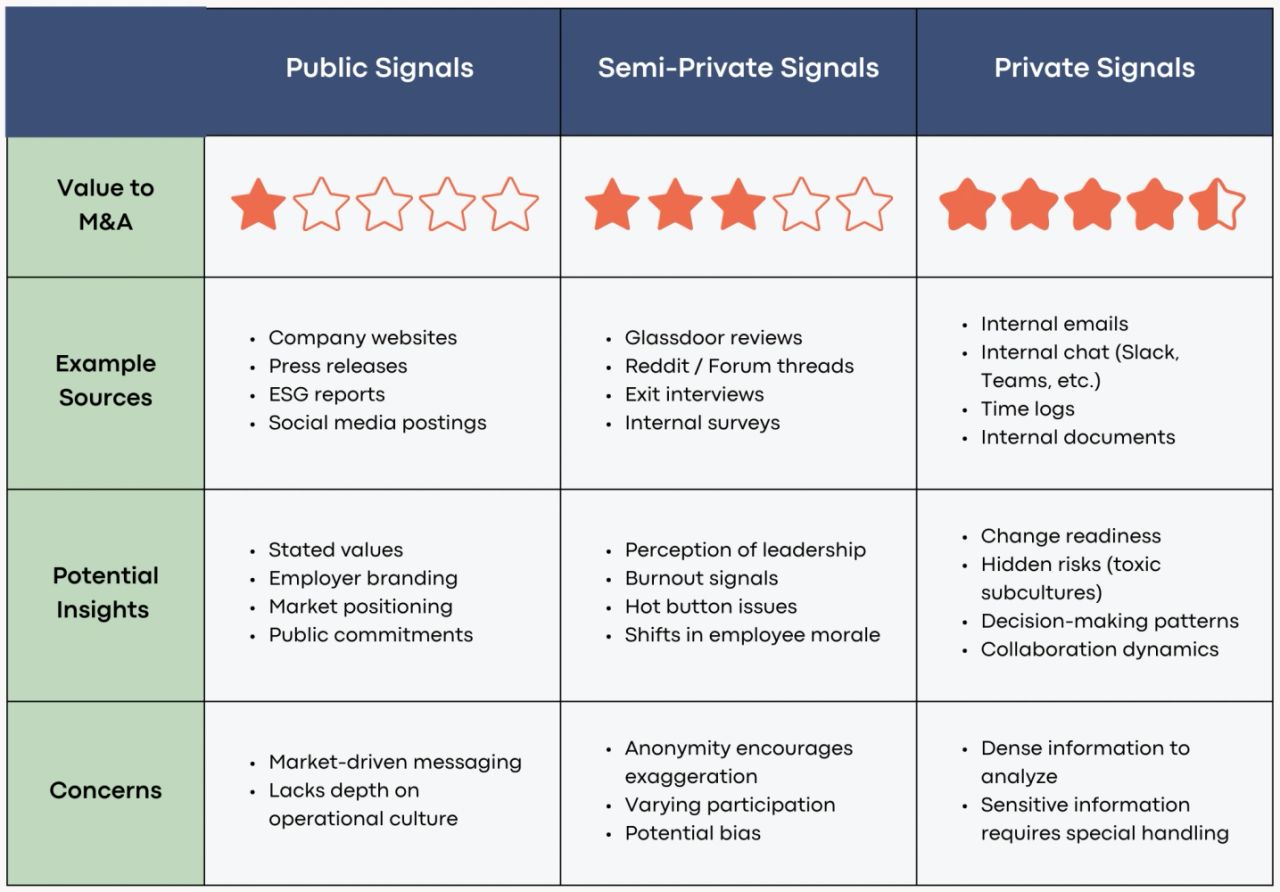
Table: Cultural Signal Source Attributes
Organizational culture is a strategic enabler for value generation and a potential critical deal risk. Yet, despite its importance, it remains notoriously hard to assess in due diligence; especially with compressed timelines and limited access to employees.
To begin to address this challenge, this article will break down each layer and what we can learn from it.
Public Signals: The Controlled Narrative
Public signals are a company’s intentional projection of identity; how it wants to be seen by the market. These signals establish values, vision, innovation, and culture in a curated and polished way.
What they include:
Some examples include company websites, press releases, thought leadership pieces, investor decks, ESG reports, and social media postings.
What we can learn:
- Stated values and priorities
- Employer branding
- Market positioning
- Thought leadership
- Public commitments
- Public facing communication style and tone
How it helps in M&A:
Analyzing public signals provides an initial view of how an organization portrays its culture externally. By comparing this public narrative with the operational culture reflected in other signals, we can uncover discrepancies. Such differences may highlight deal risks if they lead to internal friction within the company.
Public signals can also be used to assess how well the two organizations align in their external presence. Validating this alignment helps shape a unified narrative that builds trust with customers, partners, and the broader market. By ensuring consistency, the resulting company can deliver clear and cohesive messaging.
Signal Risks:
These signals are often marketing-driven. They often show what the company believes it should be, not necessarily what it is. Over-reliance on public signals can lead to overconfidence in alignment when considering an acquisition.
The signals also lack the depth and detail necessary to gain insights on the operational norms of the company. They do not give clear insight on many traits necessary to understand deal risk, such as differences in decision making patterns, communication tone, organization structure, and collaboration style.
How they are used today in M&A:
Public signals are used for surface-level, reputational and messaging alignment analysis. They validate company branding narratives, but should not be a primary source of support for deal risk analysis or integration planning.
Semi-Private Signals: The Unfiltered Middle Layer
Semi-Private signals are anonymous and/or crowdsourced. These signals reflect how employees experience the culture – especially when it differs from official messaging. They are a closer representation of the operational culture but are still filtered, anonymized and/or aggregated.
What they include:
Some examples include Glassdoor reviews, Reddit threads, exit interviews, internal pulse surveys, and anonymized engagement data.
What we can learn:
- Perception of leadership and management
- Burnout signals
- Pain points in communication or processes
- Hot button issues and red flags
- Shifts in employee morale
How it helps in M&A:
These signals surface points of cultural friction or morale issues within the organization. They demonstrate how employees react or feel about the organization and guide due diligence teams when completing deeper examinations.
During integration, they can provide an early warning sign if changes are not being well received by employees. These signals should be periodically monitored to detect any material shifts in morale.
Signal Risks:
Anonymity encourages candor, but also exaggeration. Review sources, such as Glassdoor, are polarized and tend to capture the very happy or the very upset.
Survey executions vary in participation and vigor, with directed questions limiting what is captured. Furthermore, survey fatigue can lead to neutral responses, missing deeper insights.
These signals are also lagging indicators. Posts, survey results, etc., often reflect past events or decisions, and not the current or go forward direction of the organization.
There is also the potential of gamesmanship; companies can plant anonymous entries to skew results.
In summary, semi-private signals are a better indicator of operational culture than public signals, but have limitations that should be considered when relying on the outcomes for detailed planning exercises.
How it is used today in M&A:
Today deal teams use semi-private signals as a source of guidance in the due diligence process. They can be used as a soft check for corporate development to identify any red flags and used to guide face to face interviews to gather further information.
Private Signals: The Operational Core
Private signals are where operational culture lives – in how people communicate, make decisions, escalate issues, and collaborate day-to-day. Unlike external messaging or anonymous commentary, private signals are unfiltered behavioral data.
What they include:
Some examples include emails, Slack/Teams messages, meeting transcripts, decision logs, internal documents, org charts, reporting lines, and time logs.
What we can learn:
- Leadership styles and tone
- Collaboration dynamics
- Decision-making patterns
- Engagement and morale
- Innovation Profile
- Change readiness
- Hidden risks (toxic subcultures, silos)
How it helps in M&A:
Private signals unlock operational culture – crucial for integration planning and identifying deal risks. They reveal where the merging of two companies will clash by comparing differences in how they operate. By focusing on the highest impact, this level of insight will allow for precision in change management, onboarding, and communication rollout.
Risk of Misinterpretation:
These signals are rich but dense. Capture of the signals requires a systemic approach to analyze the volume of content. This cannot be done manually or by traditional means, and to do at scale, requires natural language processing (NLP), advanced embeddings and analysis.
There are also data privacy, sensitivity and ethical considerations that must be handled properly to meet current compliance regulations and requirements.
Private Signals and the Future of M&A:
Private signals are largely untapped in M&A. Deal teams rely on public content, interviews and anonymous surveys, missing the real patterns of collaboration, decision-making and cultural alignment that can make or break deal success.
Cultara is built to unlock this signal layer at scale, turning dense unstructured communications into actionable, measurable cultural intelligence that directly supports deal value and talent retention.